According to Google, literary agents reject 88 to 96 per cent of queries from authors without reading the manuscript. They then reject 85 to 95 per cent of the manuscripts they do read.
How do you like those odds? If you were gambling money, instead of the hours you spent writing, sacrificing the other things you could have been doing, would you even consider the bet?
In addition, how much time are you willing to spend researching to identify the agents who represent the genre you write in, and then composing a query, which in 300 words or fewer, captures the essence of of a manuscript consisting of anywhere between 80,00 words to 200,000? The agent will spend an avarage of 30 seconds reading your query. And then how long are you willing to wait for the answer? The average time it takes for authors to find an agent is 6 months to a year. And then the average time between a publisher signing an author and the book’s release to the market is from 1 to 2 years.
How much contol do you want? Only the top selling authors like Stephen King have contracts that allow consultation over the cover, for instance. The publisher, not the author, decides how much money and human effort will be allocated to marketing and publicity. And your book will hardly sell at all if you don’t spend a lot of your own time and at least some of your own money on marketing.
How much money do you hope to make? According to Google, the average traditional publisher advance is $3,000, skewed way upwards by the 1 per cent who sell 50,000 to 100,000 books, while 85% of books fail to sell 5,000 copies which is considered break-even. And roughly 15 percent sell fewer that 12 copies! Not a dollar is paid for royalties until the book earns out the advance. Then subtract 15% for the agent’s fee.
Clearly, this is not a business model that works for most authors.
But it hasn’t always been that way. Once upon a time, tradtional publishers answered only to themselves. Now they are part of massive national or international conglomerates whose only focus is on profit. That is a very different model from the organizations whose only focus was on bringing books to market. Nobody went to work for a publishing house who wasn’t in love with books. I know because I grew up in the 1950’s in Riverside, Connecticut where Mr Harcourt, Mr Brace, Mr. Farrar and a high ranking executive of Doubleday were neighbors and my parents friends, and also because my wife worked for Doubleday for a short time. They came to dinner at our house. Guess what they talked about. Books- why they just had to publish a book they admired. They were way more willing to take a chance on an author than the big five publishers are today. Years ago, in 2005, I asked Tom Jenks, who had recently left Scribners, where he’d edited many big name writers to found Narrative Magazine, if my novel, Saving Miss Oliver’s, which he had just finished editing for me, would find a publisher. His response: “Ten years ago in a heartbeat.” (More about that in a later post not yet written)
I believe that this change from focus on books to focus exclusively on profit will continue until most serious authors will abandon traditional publishing entirely. Many serious authors already have. Forget all the amateur writers who put up a book on Amazon that nobody but their mothers will read. Think, instead, about the 48.8 per cent of committed, professional author publishers writers who make at least $20,00 per year and the 20% who reach six figures. They make more money for each book sold than traditional publisher pay for the simple reason they don’t have to share the profit with a publisher. Amazon will pay up to 70 percent of list price minus prduction cost for a paperback. Traditional publisher royalties range from 8 to 15 per cent.
Whatever doesn’t work any more in whatever field inevitably is abandoned in favor of whatever does work.
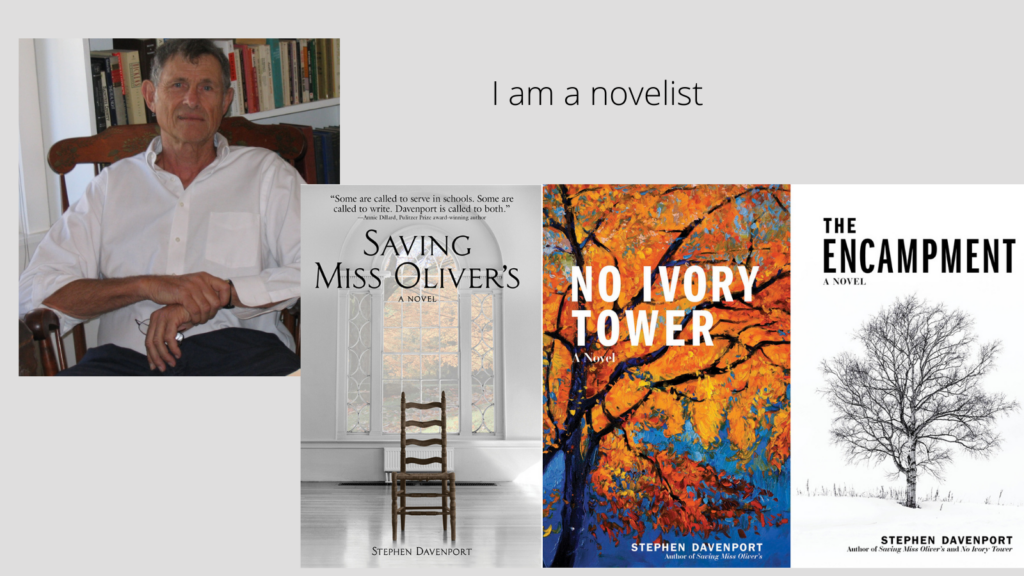
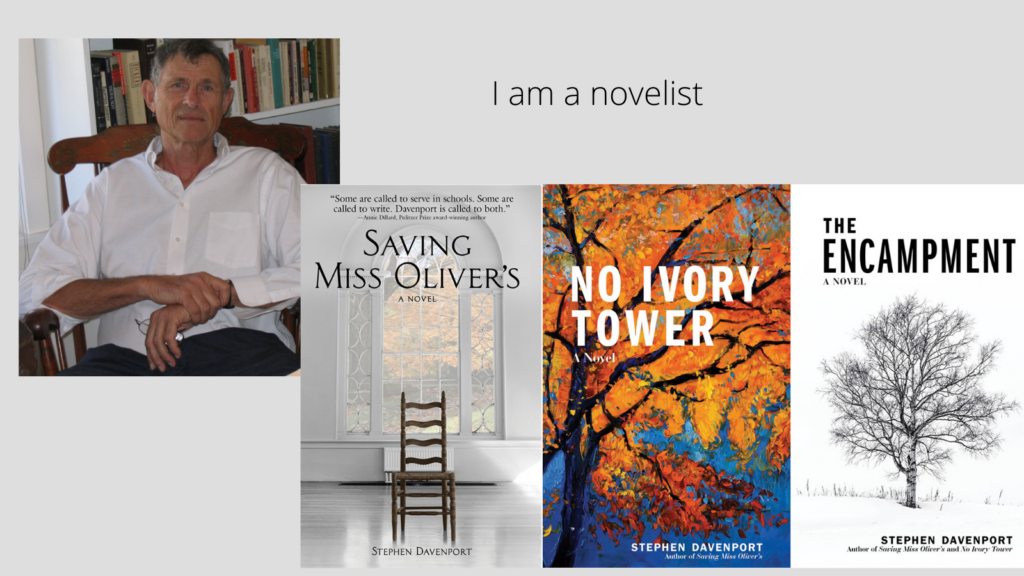
When I set out to write Saving Miss Oliver’s, the first novel in a trilogy set in a boarding school for girls, I had no idea I was writing a case study. I was just instinctively following the maxim, famously expressed by Mark Twain and Ernest Hemingway, write about what you know about.
I’d had a long, successful career in independent schools as an English teacher and department head, followed by fourteen years as head of two schools and ten summers as director of a boarding camp, and was presently working as a consultant to boards, faculties, heads and search committees. I had experienced or witnessed or heard of everything that can happen in independent schools. But I was only dimly aware of the patterns, the similarities of devasting events that happen over and over again.
All I wanted to do was write a novel that would break your heart and also serve as witness to the humanity of a leader who sacrifices “success” to stay to true to his moral compass.
So I found myself making up Fred Kindler, a young male head of Miss Oliver’s School for Girls, the immediate successor to Marjorie Boyd, the beloved, authoritarian whom the board had at last found the courage to fire only because the school was on the verge of bankruptcy. She had focused her prodigious charisma on the curriculum and pedagogy and so fiercely defended the feminist mission of empowering young women that the school was beloved by all its constituencies, especially the alumnae whose lives the school had indeed enlarged. But the financial management side of her job had been unworthy of her passion.
So here comes, the young, naïve Fred Kindler, whose first move everyone suspects will be to admit boys, following a beloved leader, whose authoritarianism has made children out of the faculty. How else can they show loyalty to her than to hate the new head, who has also committed the unpardonable sin of being male?
Perhaps Fred can garner some sympathy if he immediately makes public that he and his wife are grieving for the daughter they would have enrolled in Miss Oliver’s had she not been recently killed in a car accident. But their grief is a privacy that the Kindlers honor, and even if it were not, Fred doesn’t want to demean it by making it into a strategy of his leadership.
Instead, he chooses the strategy of garnering the support of Francis Plummer, the legendary teacher beloved by the alumnae, and the board, all of whom are alumnae, or wealthy parents of currents students. But Francis has unconsciously made a kind of parent out of Marjorie and will have no part in even tinkering with the ways things have been done at Miss Oliver’s School for Girls since the beginning of time.
However, Francis’ wife Peggy was beloved and approved of by her parents. She loves and respects Marjorie too, but she’s her own boss and understands the need for change and supports the new head. Thus, the Plummers’ marriage, already unstable, is endangered, a family dysfunction caused by the larger dysfunction the board has created by failing to supervise Marjorie, thereby encouraging her to dominate in their domain as well as her own. If that’s not a classic problem that makes good governance impossible there isn’t one.
At first, I didn’t realize that Saving Miss Oliver’s was not about a problem that happened to happen because I happened to imagine it, but about what I had to write about because it always happens when an autocratic head usurps a pliant board’s foundational responsibility – a situation present in far too many independent schools,
I finally understood that I was writing a case study when I remembered giving a lecture about being sure you understand what you are getting into at what was then called The New Head’s Workshop, sponsored by the National Association of Independent Schools. One of the newly appointed heads, whom I will call Mary, burst into tears, jumped up from her chair and ran out of the room. It was the third week of July. Mary’s headship of a well-known, prestigious boarding school for girls had just started on July 1, and she had just learned that her headship was in great danger, if not doomed.
During the afternoon recreation time, I invited Mary to take a walk with me.
She told me that the board had given her a mandate to upgrade the faculty. In other words: Fire some teachers and maybe an administrator or two. I didn’t need to ask her if the rest of the staff would be relieved, grateful to her for doing the unpleasant job that the previous head should have done, probably a while ago, but absolutely before a new head started her tenure. If the answer had been ‘yes,’ she wouldn’t have burst into tears. In fact, the teachers who needed to be let go had been there a long time and though they had gotten stale, were well liked by their peers, and alumnae, if not beloved. The same was true of the head, whom the board had finally found the courage to ease out, gently, with the most important part her job, sustaining the excellence of the faculty, undone.
I suggested to Mary that she call the board chair that very day and make an appointment with her and the executive committee of the board to be held soon after the workshop. Thinking that the board would respect the advice provided by an NAIS sponsored workshop, I advised her to convey how she’d learned that clarity around the mandate and recognition of the political dangers it could engender were critical. She did so, but the conversations must have been unsuccessful. She was notified in March that her term would end on July 1. It’s easy to imagine how painful were her last three humiliating months as a powerless leader. She deserved much better.
A few years after Saving Miss Oliver’s was published. I designed and moderated several case study workshops based on the novel for aspiring and recently appointed heads of school. The homework was to read the book. The design of the workshop required no genius to invent. All Dan White, an experienced and successful school head, and I did to moderate was break the attendees into groups of eight and ask them to “be” experienced heads of schools designing wise advice and counsel to their friend, the young, honorable, beleaguered Fred Kindler. The workshops received high praise in the evaluations for causing those who were already heads to think deeply and exchange ideas about their own board head relationships and for the aspiring heads to bring a deeper, more nuanced understanding to whatever headship they are offered in the not distant future.
Later, I wrote the second novel in the trilogy, No Ivory Tower, about a public relations scandal around sexual abuse of a student by a young, married teacher. Because there is hardly ever an issue in a school that is uncomplicated, and because I needed a compelling subplot, I created an abused student, Claire, who was almost totally innocent of the power of her beauty and charisma and need for adventure – and gave to the perpetrator of this banal and disgusting offence a malleability that arose from his not understanding that he was the one who was being seduced.
But I didn’t make this situation out of whole cloth. During my tenure as head of the Athenian School, a school I still love as one loves a person, a relationship between a teacher and student had the potential of becoming disastrous to both individuals and the school’s reputation. It was nipped in the bud, before it became widely known, by the wisdom, kindness and professionalism of the school’s counselor and dean of students working together. I didn’t know about this until after the problem had been solved, and only because the dean and counselor thought I needed to be alert in case an exaggerated version of the “news” leaked out.
The essence of “No Ivory Tower, what makes it work as a story and a case study about managing public relations disasters, is the threat to the school’s reputation caused by a radio broadcaster, with a large, mostly male, mostly right wing audience, who is angry because his wife, from whom he is divorced and has sole custody of their daughter, has outraged him by enrolling his daughter in Miss Oliver’s school for girls, where he is sure that such licentious behavior as Claire’s is not just allowed, but celebrated. What drives him really crazy is that his daughter, a close friend of Claire, loves being embraced by the Miss O community where she is learning how to be exactly what he isn’t: a clear thinker with an open mind.
The Encampment, the third and last novel in the trilogy, is a case study of the kind of difficult, deeply personal and painful decisions which have to be made about schooling and parenting that often estrange the child from her parents, unless, and only unless, the parent is able to back away and let the child make her own decisions. The Encampment tells the story of a girl who happens to be the head of school’s daughter breaking the only two rules for which expulsion is automatic in order to help a homeless man. I didn’t think of The Encampment as a case study while I was writing it. Nor, believe it or not, was I thinking of it as fiction – which engenders the question: what is fiction?
All serious fictions, especially those which are vastly more significant than the three in the Miss Oliver’s School for Girls saga, are, at their heart case studies. Think of The Adventures of Huckleberry Finn, how Huck’s experiencing a long hazardous, eventful trip down the Mississippi River with a magnificent soul, the enslaved Jim, turns Huck’s world upside down so that deep down he knows the truth. Read that book again and ponder a while and tell me how much you still admire George Washington. Did he really refuse another term in the presidency to save the brand-new nation from autocracy? Or did he hanker to get back to his life in a mansion that had a beautiful view of the Potomac from its position on a slave labor camp where people whom he could buy sell, rent, put up as collateral for loans and separate from their families made his living for him?
Why did Odysseus take so long to get back to his wife, killing all of his crewmates in the process, if it wasn’t a combination of curiosity and hunger for adventure? And why did Tennyson write a poem about Ulysses, the other name for Odysseus, leaving his wife long after he had returned to her, because he’d learned that living with a person who hadn’t seen the world, let alone slept with a goddess was, well – boring?
Didn’t Eve eat the apple, brought to her by a sneaky old snake, so she could develop the imagination to wonder if life would be better in some other place?
And then there’s The Great Gatsby, by Scott Fitzgerald, The Death of a Salesman, by Arthur Miller and The American Tragedy, by Theodore Dreiser, three different authors who wrote the same story about what happens to a person who chooses to believe that he can live the Great American Dream, if he just works hard enough.
Long ago Bernard Devoto wrote that we read novels to learn how best to behave in our big moments.
When I set out to write Saving Miss Oliver’s, the first novel in a trilogy set in a boarding school for girls, I had no idea I was writing a case study. I was just instinctively following the maxim, famously expressed by Mark Twain and Ernest Hemingway, write about what you know about.
I’d had a long, reasonably successful career in independent schools as an English teacher and department head, followed by fourteen years as head of two schools and ten summers as director of a boarding camp, and was presently working as a consultant to boards, faculties, heads and search committees. I had experienced or witnessed or heard of everything that can happen in independent schools. But I was only dimly aware of the patterns, the similarities of devasting events that happen over and over again.
All I wanted to do was write a novel that would break your heart and also serve as witness to the humanity of a leader who sacrifices “success” to stay to true to his moral compass.
So I found myself making up Fred Kindler, a young male head of Miss Oliver’s School for Girls, the immediate successor to Marjorie Boyd, the beloved, authoritarian whom the board had at last found the courage to fire only because the school was on the verge of bankruptcy. She had focused her prodigious charisma on the curriculum and pedagogy and so fiercely defended the feminist mission of empowering young women that the school was beloved by all its constituencies, especially the alumnae whose lives the school had indeed enlarged. But the financial management side of her job had been unworthy of her passion.
So here comes, the young, naïve Fred Kindler, whose first move everyone suspects will be to admit boys, following a beloved leader, whose authoritarianism has made children out of the faculty. How else can they show loyalty to her than to hate the new head, who has also committed the unpardonable sin of being male?
Perhaps Fred can garner some sympathy if he immediately makes public that he and his wife are grieving for the daughter they would have enrolled in Miss Oliver’s had she not been recently killed in a car accident. But their grief is a privacy that the Kindlers honor, and even if it were not, Fred doesn’t want to demean it by making it into a strategy of his leadership.
Instead, he chooses the strategy of garnering the support of Francis Plummer, the legendary teacher beloved by the alumnae, and the board, all of whom are alumnae, or wealthy parents of currents students. But Francis has unconsciously made a kind of parent out of Marjorie and will have no part in even tinkering with the ways things have been done at Miss Oliver’s School for Girls since the beginning of time.
However, Francis’ wife Peggy was beloved and approved of by her parents. She loves and respects Marjorie too, but she’s her own boss and understands the need for change and supports the new head. Thus, the Plummers’ marriage, already unstable, is endangered, a family dysfunction caused by the larger dysfunction the board has created by failing to supervise Marjorie, thereby encouraging her to dominate in their domain as well as her own. If that’s not a classic problem that makes good governance impossible there isn’t one.
At first, I didn’t realize that Saving Miss Oliver’s was not about a problem that happened to happen because I happened to imagine it, but about what I had to write about because it always happens when an autocratic head usurps a pliant board’s foundational responsibility – a situation present in far too many independent schools,
I finally understood that I was writing a case study when I remembered giving a lecture about being sure you understand what you are getting into at what was then called The New Head’s Workshop, sponsored by the National Association of Independent Schools. One of the newly appointed heads, whom I will call Mary, burst into tears, jumped up from her chair and ran out of the room. It was the third week of July. Mary’s headship of a well-known, prestigious boarding school for girls had just started on July 1, and she had just learned that her headship was in great danger, if not doomed.
During the afternoon recreation time, I invited Mary to take a walk with me.
She told me that the board had given her a mandate to upgrade the faculty. In other words: Fire some teachers and maybe an administrator or two. I didn’t need to ask her if the rest of the staff would be relieved, grateful to her for doing the unpleasant job that the previous head should have done, probably a while ago, but absolutely before a new head started her tenure. If the answer had been ‘yes,’ she wouldn’t have burst into tears. In fact, the teachers who needed to be let go had been there a long time and though they had gotten stale, were well liked by their peers, and alumnae, if not beloved. The same was true of the head, whom the board had finally found the courage to ease out, gently, with the most important part her job, sustaining the excellence of the faculty, undone.
I suggested to Mary that she call the board chair that very day and make an appointment with her and the executive committee of the board to be held soon after the workshop. Thinking that the board would respect the advice provided by an NAIS sponsored workshop, I advised her to convey how she’d learned that clarity around the mandate and recognition of the political dangers it could engender were critical. She did so, but the conversations must have been unsuccessful. She was notified in March that her term would end on July 1. It’s easy to imagine how painful were her last three humiliating months as a powerless leader. She deserved much better.
A few years after Saving Miss Oliver’s was published. I designed and moderated several case study workshops based on the novel for aspiring and recently appointed heads of school. The homework was to read the book. The design of the workshop required no genius to invent. All Dan White, an experienced and successful school head, and I did to moderate was break the attendees into groups of eight and ask them to “be” experienced heads of schools designing wise advice and counsel to their friend, the young, honorable, beleaguered Fred Kindler. The workshops received high praise in the evaluations for causing those who were already heads to think deeply and exchange ideas about their own board head relationships and for the aspiring heads to bring a deeper, more nuanced understanding to whatever headship they are offered in the not distant future.
Later, I wrote the second novel in the trilogy, No Ivory Tower, about a public relations scandal around sexual abuse of a student by a young, married teacher. Because there is hardly ever an issue in a school that is uncomplicated, and because I needed a compelling subplot, I created an abused student, Claire, who was almost totally innocent of the power of her beauty and charisma and need for adventure – and gave to the perpetrator of this banal and disgusting offence a malleability that arose from his not understanding that he was the one who was being seduced.
But I didn’t make this situation out of whole cloth. During my tenure as head of the Athenian School, a school I still love as one loves a person, a relationship between a teacher and student had the potential of becoming disastrous to both individuals and the school’s reputation. It was nipped in the bud, before it became widely known, by the wisdom, kindness and professionalism of the school’s counselor and dean of students working together. I didn’t know about this until after the problem had been solved, and only because the dean and counselor thought I needed to be alert in case an exaggerated version of the “news” leaked out.
The essence of “No Ivory Tower, what makes it work as a story and a case study about managing public relations disasters, is the threat to the school’s reputation caused by a radio broadcaster, with a large, mostly male, mostly right wing audience, who is angry because his wife, from whom he is divorced and has sole custody of their daughter, has outraged him by enrolling his daughter in Miss Oliver’s school for girls, where he is sure that such licentious behavior as Claire’s is not just allowed, but celebrated. What drives him really crazy is that his daughter, a close friend of Claire, loves being embraced by the Miss O community where she is learning how to be exactly what he isn’t: a clear thinker with an open mind.
The Encampment, the third and last novel in the trilogy, is a case study of the kind of difficult, deeply personal and painful decisions which have to be made about schooling and parenting that often estrange the child from her parents, unless, and only unless, the parent is able to back away and let the child make her own decisions. The Encampment tells the story of a girl who happens to be the head of school’s daughter breaking the only two rules for which expulsion is automatic in order to help a homeless man. I didn’t think of The Encampment as a case study while I was writing it. Nor, believe it or not, was I thinking of it as fiction – which engenders the question: what is fiction?
All serious fictions, especially those which are vastly more significant than the three in the Miss Oliver’s School for Girls saga, are, at their heart case studies. Think of The Adventures of Huckleberry Finn, how Huck’s experiencing a long hazardous, eventful trip down the Mississippi River with a magnificent soul, the enslaved Jim, turns Huck’s world upside down so that deep down he knows the truth. Read that book again and ponder a while and tell me how much you still admire George Washington. Did he really refuse another term in the presidency to save the brand-new nation from autocracy? Or did he hanker to get back to his life in a mansion that had a beautiful view of the Potomac from its position on a slave labor camp where people whom he could buy sell, rent, put up as collateral for loans and separate from their families made his living for him?
Why did Odysseus take so long to get back to his wife, killing all of his crewmates in the process, if it wasn’t a combination of curiosity and hunger for adventure? And why did Tennyson write a poem about Ulysses, the other name for Odysseus, leaving his wife long after he had returned to her, because he’d learned that living with a person who hadn’t seen the world, let alone slept with a goddess was, well – boring?
Didn’t Eve eat the apple, brought to her by a sneaky old snake, so she could develop the imagination to wonder if life would be better in some other place?
And then there’s The Great Gatsby, by Scott Fitzgerald, The Death of a Salesman, by Arthur Miller and The American Tragedy, by Theodore Dreiser, three different authors who wrote the same story about what happens to a person who chooses to believe that he can live the Great American Dream, if he just works hard enough.
Long ago Bernard Devoto wrote that we read novels to learn how best to behave in our big moments.
Should I seek a traditional publisher, or self publish?
Another way to ask the question is how long do you want to wait to see your book on the market? It takes much less time to self-publish than to go to the traditional route.
It wasn’t so very long ago that the term “self-publishing” didn’t exist. The term was “vanity publishing.” But that was back in the “good old days” when a decent book had a much greater chance of being published by a well- known publisher. Now, to land a contract with a traditional publisher you have to land an agent. And that means you have to be as good at writing a query letter, which in fewer than 300 words entices the agent to read the manuscript, as you are at writing the book in the first place.
Maybe you are that writer. I know from experience that I am not.
Even with the powerful, web-based Query Tracker, which helps us identify agents who represent books in the categories we write in, the job of finding, or failing to find, an agent takes a whole lot of time, energy and worry that we could spend on writing our next book.
My quick survey via Query Tracker reveals agents’ acceptances rates are less than 2%. Think about that. Two percent!
Well, then, you ask, why in the world try to land a traditional publisher?
The most compelling reason is that there is no more powerful affirmation of the value of our books , and of ourselves as writers, than a publisher’s judgement that a lot of people will want to read our books. Otherwise why would a publisher spend resources on getting them to market? Don’t we all ask ourselves, in the middle of sleepless nights, “How good am I really?” Traditional publishers, especially the big five and their various imprints, are the major leagues. Isn’t that where we all want to play?
Another powerful reason is that we have to spend our own money to self-publish our work. Copy editing is a must. So is professional book design of the cover and interior. There goes at least three thousand dollars. And what about professional developmental and line editing? I would not even dream about submitting a manuscript to an agent without first researching to find a highly competent professional editor to go over it with a fine tooth comb, and then using that edit to revise and polish. There goes at least another two thousand dollars. Writers who have enough faith in their own work alone will not use a professional editor, assuming that the agent and/or publisher will do that job for them. Not me. The chances of landing an agent are already small enough.
And there are other powerful reasons. Running a self-publishing business takes even more time and energy than finding an agent. We have to learn the whole business. What’s the most advantageous and accurate meta data for our book? Who should be the copy editor? The Book designer? How much can we afford to pay them? What will be the ROI? And, as self-publishers, we have to do all the marketing. Books are particularly difficult to market. How to keep our books from getting lost among the thousands of books that will be published today? It is impossible to sell anything that no one knows exists. There is no question that a traditional publisher will have more heft in the market than a self publisher.
Nevertheless, every publisher expects their writers to work hard at marketing their books.
On the other hand, there are important advantages to self-publishing. If we do all the work, we keep control over every element. Most important: the cover. The traditional publisher might, or might not, ask the author’s opinion, but will make the decision. What if the author doesn’t like it, or prefers another choice? How hard would it be emotionally to have the book you have have spent so much of yourself on have a look you dislike? Or feel that it suggests to the reader a different book that you’ve spent your talent on?
Remember, it is your talent that counts, not the publisher’s. Without writers there is no publishing. Talent is rare. Otherwise it isn’t talent. If you have it, respect it. Consider assuming the attitude that your book has a high value. If agents and publishers aren’t smart enough to recognize your talent, its their loss not yours.
Maybe your self published book will find a satisfyingly capacious audience – and another maybe – its good sales will entice an agent to represent it to publishers.
And how long are you willing to wait for the book to be available to readers? A well designed self-publishing program for a given book can be as brief as six months from the beginning of the process to launch day. The average time spent from when you start writing query letters to a publisher launching a book is 2 to 4 years! Add to that the time you spent writing the book – if not at least two years for a novel, it’s probably not worth reading. So, it could be six years. Are you that patient?
And, believe it or not, even after all the expenses, we just might make more money self-publishing our books. Traditional publishers pay royalties ranging from 10% to 15%. On Amazon, a self-published e book will earn a 70% royalty, and a paperback 60% after the cost of printing. Maybe you could sell fewer books, but make more money.
Just remember, it won’t be easy.
I have arrived, at last at my own “come to Jesus” moment. I have made a decision about which way to go. Proceed with both processes simultaneously. Decide not to decide until I know more.
Yes, I know, that sounds insanely indecisive, but but is actually more indecisive to proceed with one concrete option vs another that is entirely speculative.
So, I will figure out how long I am willing to wait until Sacred Places, a novel I have recently completed, is available to readers. That will be the launch day of a detailed, step by step self-publishing process designed by a trusted professional with whom I have already contracted. Simultaneously, I will use the research I have already done on query tracker, and the time already spent on developing the query letter, to continue to try find an agent. If I’m successful I will have more knowledge and understanding than I do now to decide whether to accept the agent’s offer or continue the self-publishing process to the finish line.
Like a lot writers, I don’t know what I know until I try to write it. What I have realized while writing this is that I don’t want anymore to be the writer who needs an agent, and can only hope. I want to be the writer the agent needs.
“I’m looking forward to our reunion. We have much to catch up on. Thank you. Welcome, home, old friend.”
What was your reaction to these words, the conclusion of Gerald Ford’s posthumous eulogy to Jimmy Carter, spoken by his son, Steve Ford at Jimmy Carter’s funeral? I am sure you were moved
Mine was to burst into tears.
Redemptive words, spoken in a holy place. A blessing for all of us. Two persons, rivals for the presidency, connected by respect, admiration and affection.
A few months ago, I made an audio version of Ninety-Day Wonder, How The Navy Would Have Been Better Off Without Me, a memoir I had just finished writing about my two-year hitch as astonishingly unqualified officer in the Navy from 1953 to 1955. I am now in the process of deciding whether to publish the print and audio version with a traditional publisher or to self-publish. But that’s not what I want to write about today. Instead, I want to share what the experience of narrating the book in a professional audio studio was like.
I want to share what the experience of narrating the book in a professional audio studio was like.
I had expected it to be very difficult. I thought audio studios were about the audio only. I assumed I would be on my own about pace, diction, rhythm, when and for how long to pause, or anything else that a neophyte like me would need help on when delivering a story to listeners as opposed to readers. I could not have been more uninformed. I got all the guidance I was capable of absorbing. The process was exciting, satisfying, much less difficult than I had expected, and I am very satisfied with the outcome.
I made the audio at Live Oak Studio, in Berkeley, California. I should say we made it, James Ward and I as a team. He greeted me as I entered and introduced himself as my director. That word was my first clue that he would do much more than record the sound of my voice; instead, like the director of a film, he would guide me as I read. That is exactly what James did and he did it very well.
The impact of his talking to me when out of sight was to attune me to working entirely auditorily. It was brilliant.
The impact of his talking to me when out of sight was to attune me to working entirely auditorily. What is interesting to me about his reassurance was that he did not deliver it to me face to face; instead, after he was out of sight, ensconced in another room with all the instruments for recording, and I was seated in a different room where the microphone was placed in the right relationship to me and where I donned earphones through which I would hear his direction and my voice as I read, and where an IPad opened to the manuscript of Ninety Day Wonder was mounted directly in front of me. All I would have to do was scroll down as I read. No sound of rustling pages to disturb the listener. The impact of his talking to me when out of sight was to attune me to working entirely auditorily. It was brilliant.
He told me that when I read too fast, or my voice began to sound tired, or when I slowed down too much, or mispronounced a word, he’d stop me, delete the passage, and suggest how I should re-read it, several times, if necessary, to get it right. He told me that I would get tired so we would take breaks and remind me frequently to drink the water he had provided.
He told me that when I read too fast, or my voice began to sound tired, or when I slowed down too much, or mispronounced a word, he’d stop me
Thus reassured, I started to read. As James came through on all of his promises, I got more and more relaxed and discovered I was having fun. I remembered how I had loved reading to my children and grandchildren. I heard myself bringing out nuances that might very well not be recognizable on the page. Sarcasm, self-deprecation, amazement that the events I was narrating actually happened, caused me to change my tone of voice – as when we talk to one another, we instinctively change our tone of voice to match our meanings. I felt an intimacy with the potential listeners as if they were right there in the room with me listening to me talk to them. I am convinced that the audio version of Ninety-Day Wonder is better than the print.
Nobody is better suited to tell listeners directly than the confessor.
I am not sure this would be true if it were not a memoir. Audios of novels are most often narrated by professional voice actors who play the parts of the various characters. Memoirs are more intimate. They are confessions. Nobody is better suited to tell listeners directly than the confessor. Nevertheless, I am considering making an audio of The Encampment, the latest novel in the Miss Oliver’s School for Girls Saga. After all, I wrote it. Shouldn’t I be the one who reads it out loud?
Audios of novels are most often narrated by professional voice actors who play the parts of the various characters. Memoirs are more intimate.
I am eager to learn about the experience of other writers who have made an audio book or are considering it. And from readers/listeners about their preferences: reading or listening. If you are so inclined, do so in the comments. I promise to get back to you.
The question is imperative for me because I am 95 years old. I’m worried that time will run out before I write all the books that are in my head. I have no interest whatsoever in a calm, leisurely fade. I want to die with my hands either on a computer’s keyboard, or a tennis racquet.
So I was intrigued when I came across a post online by one of the multitude of people who make their living by pumping out advice to writers, urging her readers to write a minimum of 2K words a day. “You can finish a complete draft in less than a month!”
Wow! If I write two more drafts of the novel I am writing now, each taking one month, I can finish in three months. Thus, I could write four novels in a year – the first three in the same time it takes to make a baby! Maybe I better look into this.
Her advice to writers: to write 2k words a day or more, first outline the entire novel and write the biographies of each character before you write the first word of the actual novel.
That’s good advice for some writers, but it doesn’t work for me. I’m not sure I could outline a business letter or the message on a birthday card, let alone a novel. In the second place, it would take me a year to outline the entire arc of a novel in sufficient detail to enable the production of the first draft in a month. Better to just start writing.
I’m not sure whether I start with a character I want to get to know or the situation she finds herself in.
Finding the way without an outline
All I knew when I started writing The Encampment, the third novel in the Miss Oliver’s School for Girls Series, is that Sylvia Bickham, the daughter of the head of school, was a senior there who was less motivated than her friends to compete for admission to one of the “best” colleges. She didn’t want to wait four more years to enter “real” life. I also knew that she was a person of color, like her mother, and that she would leave campus on a Saturday afternoon early in the academic year to get an ice cream cone in the nearby village. I didn’t know she had a roommate to walk with until I gave her one, Elizabeth Cochrane, from a little impoverished town in Oklahoma.
By then I realized that the two girls were going to come across a homeless Iraq war vet with PTSD. I understand now, looking back, that the homeless veteran was in my subconscious because I was, and still am, outraged that our American culture is so cruel that some of its less fortunate have to sleep on sidewalks and under bridges. I doubt that the homeless vet would have come to my mind in an outline.
I had to send the girls out of the safety of their campus to be confronted with the fact of that cruelty. As soon as they did. I knew they were going to put some money in his hat and get more and more involved with him in an effort to help him survive. And then I knew that their experience would teach both girls what they wanted to do with their lives.
Once I had that beginning established, I had a fair idea of how the novel would end, but only the next step on the path to that destination was clear, and then the next, and the next – an incremental journey during which I was frequently surprised by what the characters did. This is a much slower process, at least for me, than writing to an outline. And, for me, a whole lot more intriguing. Instead of planning, I discover.
I am very interested in how writers write. I’d like to learn from writers how many words you write each session, how fast you write your books, whether you outline before you write, and if so, in how much detail and how often what you actually write is different from what you posited in the outline. If you are so inclined, put your answers in the comment section below. I promise to get back to you.
The question is imperative for me because I am 91 years old. I’m worried that time will run out before I write all the books that are in my head. I have no interest whatsoever in a calm, leisurely fade. I want to die with my hands either on a computer keyboard or a tennis racquet.
So I was intrigued when I came across a post online by one of the multitude of people who make their living by dispensing advice to writers, urging her readers to write at least 2K words a day. “You can finish a complete draft in less than a month!”
Wow! If I write two more drafts of the novel I am writing now, each taking one month, I can finish in three months. Thus, I could write four novels in a year – the first three in the same time it takes to make a baby! Maybe I’d better look into this.
Her advice to writers is to write 2,000 words a day or more. First, outline the entire novel and write the biographies of each character before you write the first word of the actual novel.
That’s good advice for some writers, but it doesn’t work for me. I’m not sure I could outline a business letter or a birthday card message, let alone a novel. In the second place, it would take me a year to outline the entire arc of a novel in sufficient detail to enable the production of the first draft in a month. Better to just start writing.
I’m not sure whether I should start with a character I want to get to know or the situation she finds herself in.
Finding the way without an outline
All I knew when I started writing The Encampment, the third novel in the Miss Oliver’s School for Girls Series, is that Sylvia Bickham, the daughter of the head of school, was a senior there who was less motivated than her friends to compete for admission to one of the “best” colleges. She didn’t want to wait four more years to enter “real” life. I also knew that she was a person of color, like her mother, and that she would leave campus on a Saturday afternoon early in the academic year to get an ice cream cone in the nearby village. I didn’t know she had a roommate to walk with until I gave her one, Elizabeth Cochrane, from a little impoverished town in Oklahoma.
By then, I realized that the two girls were going to come across a homeless Iraq war vet with PTSD. I understand now, looking back, that the homeless veteran was in my subconscious because I was, and still am, outraged that our American culture is so cruel that some of its less fortunate have to sleep on sidewalks and under bridges. I doubt that the homeless vet would have come to my mind in an outline.
I had to send the girls out of the safety of their campus to be confronted with the fact of that cruelty. As soon as they did. I knew they were going to put some money in his hat and get more and more involved with him to help him survive. And then I knew that their experience would teach both girls what they wanted to do with their lives.
Once I had that beginning established, I had a fair idea of how the novel would end, but only the next step on the path to that destination was clear, and then the next, and the next – an incremental journey during which I was frequently surprised by what the characters did. This is much slower for me than writing to an outline. And, for me, a whole lot more intriguing. Instead of planning, I discover.
Since reading that post, I have started to keep a record of how many words I write each day. The average is 1,015.
I am very interested in how writers write. I’d like to learn from writers how many words you write each session, how fast you write your books, whether you outline before you write, and if so, in how much detail, and how often what you actually write is different from what you posited in the outline. If you are so inclined, put your answers in the comment section below. I promise to get back to you.